
The series
Gravity Series
A series about gravity, taking you from first principles through to a full understanding.
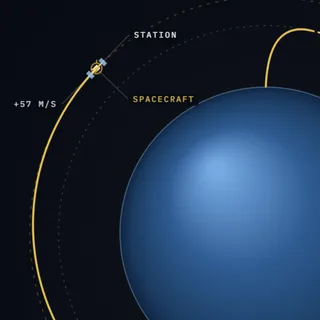
How does a rocket fly to the International Space Station?
Getting to orbit is not the hard part. The hard part is arriving where the station will be, at the moment it gets there, moving at the same speed.
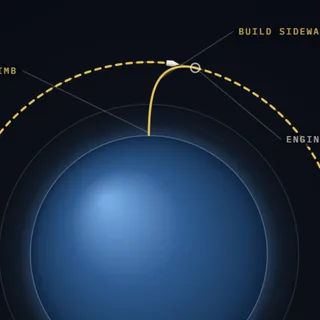
How a rocket gets into orbit
Height gets a spacecraft above the air. What keeps it there is sideways speed, and building that is most of what a launch is doing.
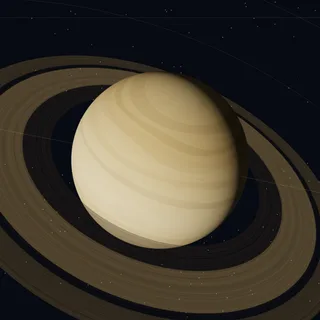
The solar system, to scale
Explore the Sun, eight planets, thirteen moons and four spacecraft, with sizes and distances shown on the same scale.
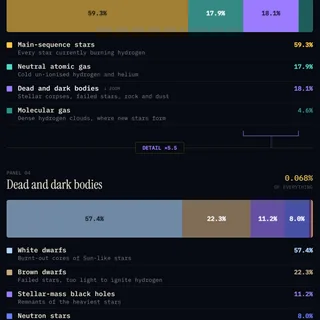
What the universe is made of
Ordinary matter makes up about 5% of the universe’s total mass and energy. The visualisation follows that share into smaller categories, showing where stars, planets and other familiar objects fit.
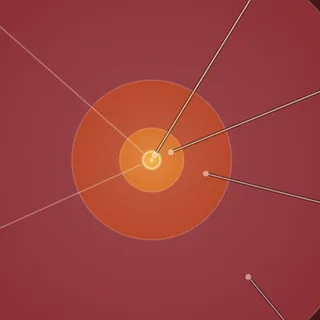
How stars die
What a star leaves behind is fixed almost entirely by what it weighed when it was born, and the heaviest ones leave nothing at all.
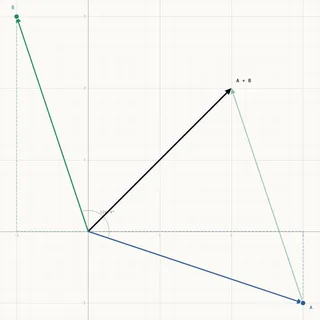
A vector calculator
Vectors describe quantities that have both a size and a direction, such as velocity, force or displacement. Use the calculators below to explore how vectors combine in two and three dimensions.
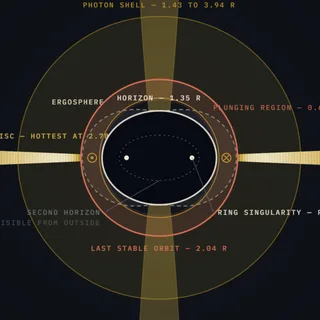
The anatomy of a black hole
Whatever falls into a black hole, all that survives of it is a weight and a spin, and those two numbers fix every layer of the thing left behind.
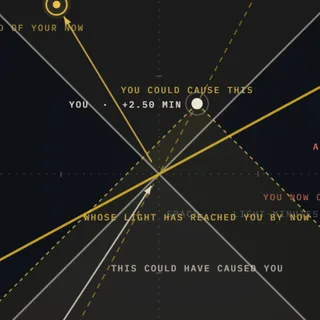
What you can see and what you can change
Light takes time to travel. This limits how soon we can learn about a distant event, and how soon anything we do can affect it. A light-cone diagram helps us explore both.
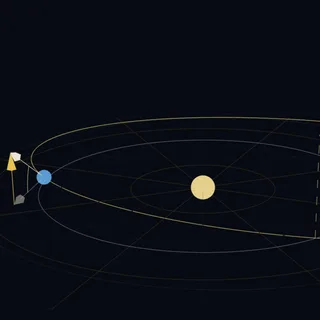
Why is it hard to fly above the solar system?
The planets orbit the Sun in roughly the same plane. Sending a spacecraft steeply out of that plane takes a large change in motion, because it starts with Earth’s orbital speed.
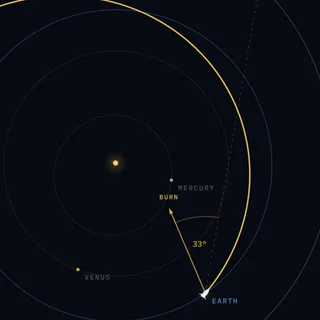
Trajectories to other planets
Reaching another planet means planning for where it will be when the spacecraft arrives. Explore how the departure date changes the journey.